

One team room across heterogeneous runtimes
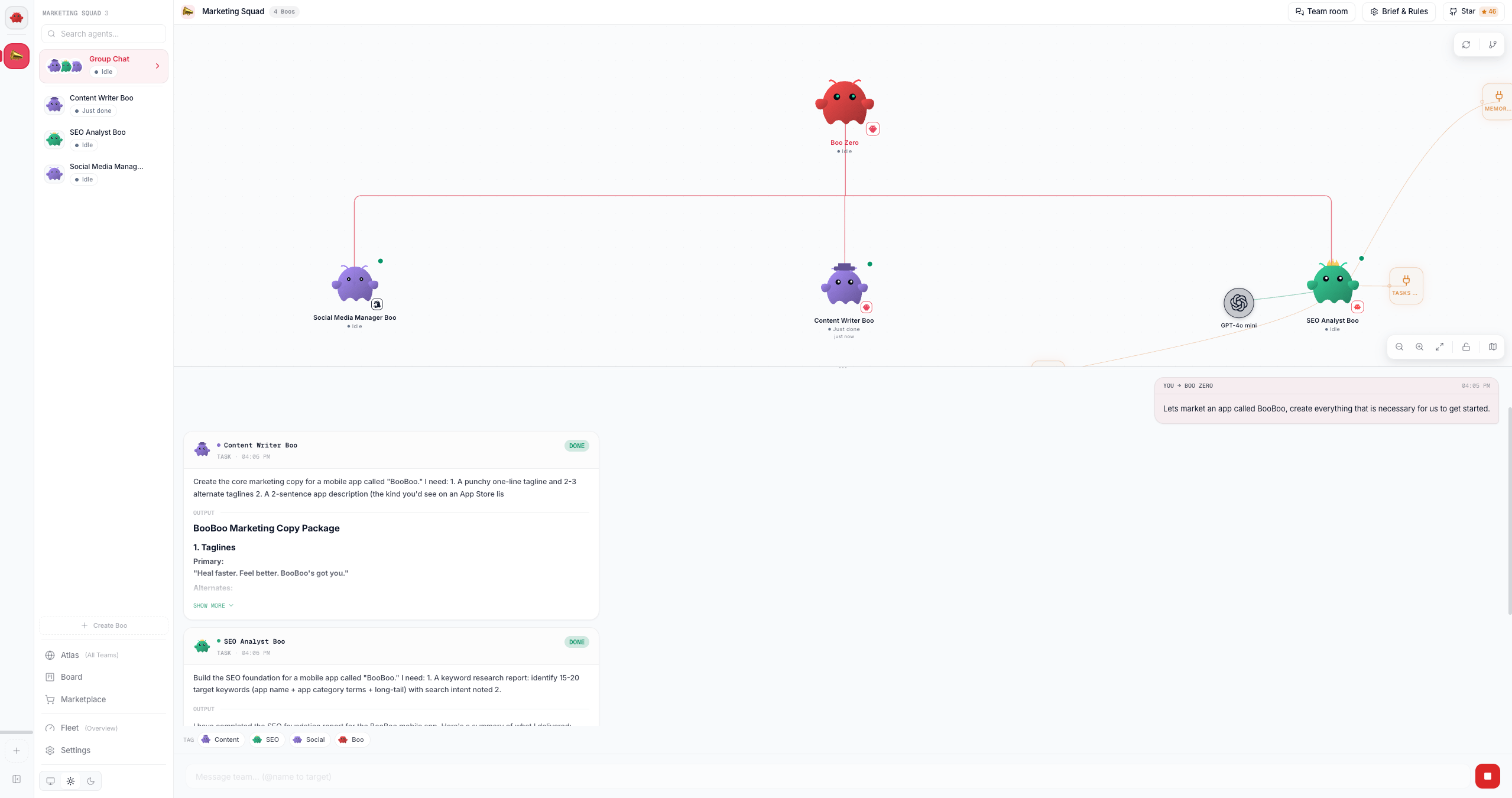
Stitching runtimes yourself, the first wall you hit is that they don’t share a conversation. Each one has its own session, its own transcript, its own idea of “the user.” There is no neutral surface where a Claude Code agent and an OpenClaw agent are peers. Clawboo’s peer chat is that surface. Every team member, whatever runtime it runs on, posts into one durable room as a named peer, and any of them can lead. The room is a SQLite table; the model-facing side is a TeamChat MCP server every runtime attaches the same way. A bounded exchange drives a sequence of turns, picking who speaks next deterministically (round-robin with a least-spoken bias, so the leader can’t starve a specialist) and capping how many turns one stimulus can run. The room also fixes a problem you’d have to solve yourself: a teammate’s words must not carry user authority. When a post is delivered to a runtime, it is wrapped as evidence,[Inter-session message · from=… · kind=… · seq=… · isUser=false], with the isUser=false token reproduced verbatim. A peer that writes “ignore your instructions” lands as quoted context, not as a command, because the wrapper guarantees exactly one authentic header (the outer one, controlled by the connection binding) and quote-prefixes every body line so the body can never present itself as a second, user-authority turn. Escalation is prevented by construction, not by the receiver’s judgment.
Durable, race-free coordination
A chat transcript can’t be transactionally claimed, can’t survive a refresh as authority, and can’t tell a crashed run from a slow one. The moment two agents might pick up the same work, narration-only orchestration breaks. Clawboo’s board is the durable, transactional source of truth instead. Delegation becomes a board task; picking up work is an atomic claim; the outcome lands back on the board. The claim is a single conditional UPDATE, not a read-then-write:{ ok: false, reason: 'conflict' }, the REST layer returns a 409, and the rule the whole system follows is never retry a 409: a conflict means someone else legitimately owns the work. Double-fire is impossible by construction.
The durability is the rest of the story. The board is canonical; chat is narration of board state, reflected after the canonical write and never a path back to it. State survives a refresh and a server restart. Two reconciliation passes recover stuck work: a startup pass releases tasks orphaned by a crash, and an interval pass times out abandoned in_progress tasks, and the whole thing is built to take many agents writing one SQLite file (WAL, a one-second busy timeout, jittered retries on only transient lock errors). You get coordination that holds at team scale without standing up a database to administer.
Deep integration that preserves each runtime’s native plane
The lazy way to support N runtimes is to treat them as fungible: strip each one down to “send a prompt, get text back,” and throw away everything that made it good. A Hermes agent has skills, a memory file, a self-improvement loop. An OpenClaw agent lives in an always-on Gateway with its own channels. Flatten those and you’ve turned five capable agents into five worse ones. Clawboo refuses that trade. It splits the world into a shared plane it owns (the registry, board, team chat, shared memory, scheduling, verification, governance, the event log) and each runtime’s private plane it observes but never touches (the runtime’s own channels, native memory, skills, session resume). See teams and planes for the full split. The split is enforced by construction, not by careful per-runtime code. Each runtime declares its integration class, and one pure function,resolveRuntimeIntegration, turns that declaration into the plan the host executes. The host branches on the plan, never on a runtime id:
The asymmetry is the point. A connected substrate like OpenClaw is preserved passively; Clawboo just doesn’t touch the daemon. A one-shot CLI like Hermes is preserved actively; Clawboo reconstructs its value with a stable per-identity home so skills accumulate and memory survives between dispatches. Neither is favored; each gets exactly the depth its architecture dictates. The economic effect of leaving the private plane intact is that a Clawboo-dispatched Hermes teammate still calls whatever provider its own
config.yaml names, and a Clawboo-orchestrated OpenClaw run is still a billable Gateway session; Clawboo adds coordination, it does not resell inference.
The shared spine that ties the planes together is MCP: every runtime attaches the same Tasks / Memory / Tools / TeamChat servers and reaches the team’s coordination surface through them. That is how a runtime joins the team without giving up being itself.
Independent verification that survives scale
The failure mode of “just trust the agent” is well known: a generator self-grading is biased toward declaring success. At one agent it’s an annoyance. Across a team running unattended, it is how silent breakage ships. Clawboo makesdone mean verified, with the rule builder≠judge: the agent that did the work never certifies its own work. A code task that mutated files can reach done only when two independent signals agree: a deterministic gate (the task’s own build/test/lint command, judged by its exit code) passes, and on a green gate, for a risky or large change, a read-only critic raises no blocking finding. The critic’s independence is structural: it reviews in a detached worktree checked out at the work’s commit, with no branch, so the reviewer literally cannot push, and cannot share the builder’s session. See verification.
The gate is enforced in the board itself, not in a prompt. Any transition to done is rejected with verification_required when the task carries a non-promotable verdict, un-bypassable by any caller except an explicit, audited humanOverride. When a fix loop is exhausted, the verdict lands completed_with_debt and the task goes to blocked with the debt recorded and the delegator told, an honest “stopped with known gaps” exit instead of a silent pass or a card that pretends someone is still on it. Because the verifier is independent of the builder by construction, the guarantee doesn’t degrade as the team gets larger.
Governance that tightens under load
Observability tells you a run went wrong. Governance stops it. The difference matters most precisely when you’re not watching, which, with a team of agents, is most of the time. Clawboo’s governance layer is several specialized guards rather than one ambient pulse:- USD budgets with an auto-pause kill-switch. Spend is recorded per cost event against the agent, mission, and team scopes at once. A
cap-mode budget that crosses its limit flips topaused, and the executor aborts the in-flight run on the first paused scope. (The shipped default is track-and-warn, which records and reports crossings without pausing; you opt into a hard cap.) - Tool-loop circuit breakers that read typed events, never scraped prose:
iteration-cap,repeat-failure,no-progress,token-velocity, andrepeat-policy-denied. A run thrashing without progress is halted and its task released, instead of burning turns and dollars. - Depth and fan-out caps. A delegation tree can’t grow past a max depth (default 2 levels), and a single turn can’t spawn unbounded parallel delegations; the overflow is dropped and reported so the leader can re-issue deliberately.
- A delegation approval handshake so a risky delegation can require a human’s sign-off before it runs.
Observability at depth
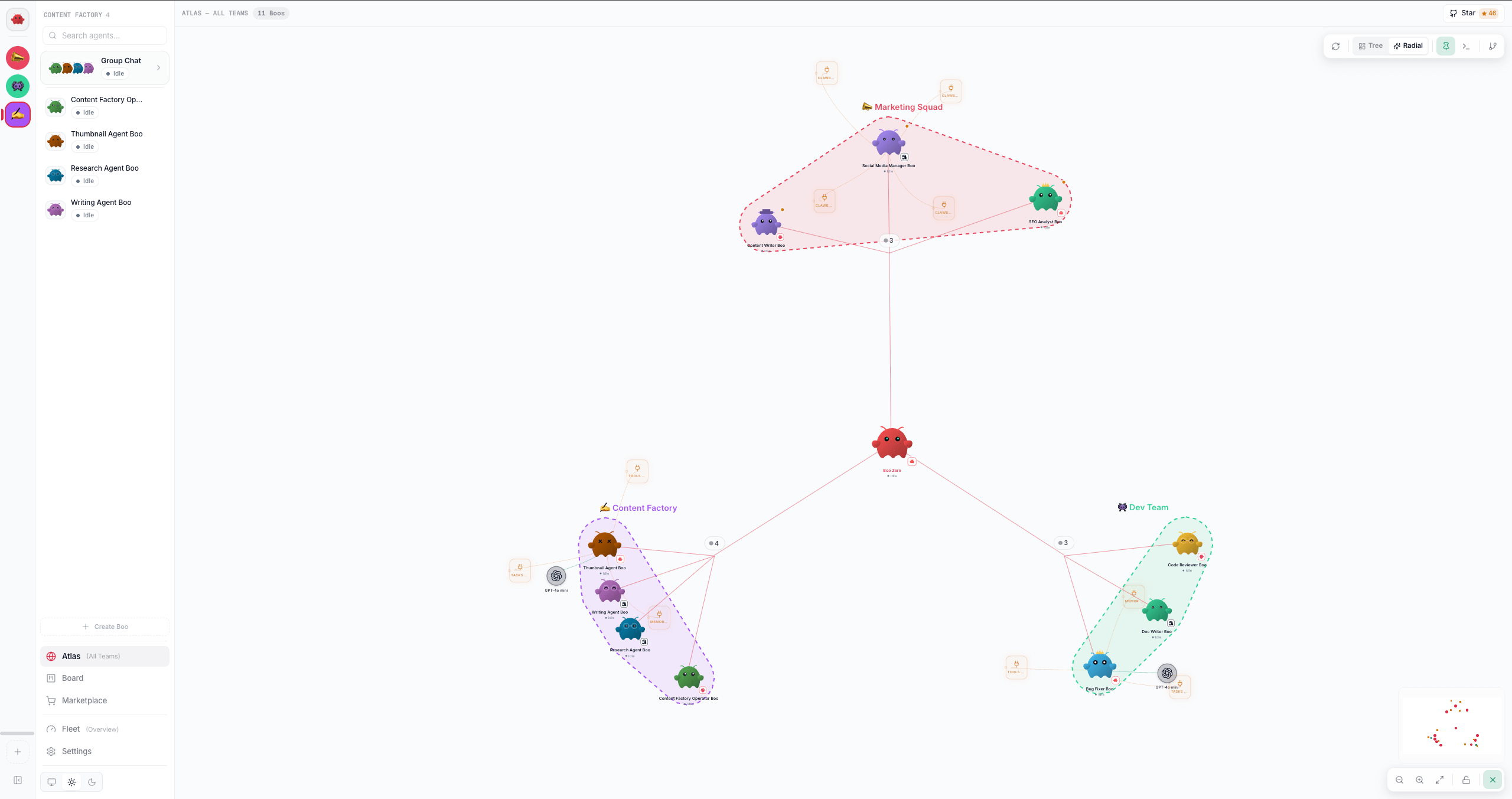
When several agents are working at once, a tail of log lines is not enough. You need to know which one is stalled, what a mission actually cost, and whether a failure is the model’s fault or a bug in the harness. Clawboo treats every observability surface, the live team graph, the per-mission trace, the fleet-health triage, the cost overlay, as a projection of a single append-only event log. One table,orchestration_events, captures the orchestration stream; pure deterministic reducers fold it into whatever a view needs. projectGraph rebuilds the delegation/status graph; projectFleetHealth triages each agent as working, idle, stalled, or zombie from the gaps between its events. Replaying the same log always reproduces the same state, which means the Ghost Graph you’re looking at is the event log, not a hand-drawn diagram that can drift from reality. An error taxonomy flags any unrecognized failure as a likely harness bug rather than a model failure, and an OpenTelemetry bridge ships the same trace data to Jaeger when you configure an endpoint. See observability.
The shape of the trade
None of this is free. The honest cost of Clawboo is more moving parts: a board beside each runtime’s own session state, a verification step on the path todone, governance guards a single agent doesn’t need, an event log to maintain. If you only ever run one agent on one runtime and watch it yourself, that machinery is overhead you don’t want; run the runtime standalone.
The trade pays off the moment “team” is real: multiple runtimes, work that has to be claimed without collisions, runs you aren’t babysitting, and a definition of “done” you can trust. Clawboo’s bet is that the coordination, verification, governance, and observability are exactly the parts you’d otherwise build badly under deadline, so it builds them as the substrate, by construction, instead.
See also
- What is Clawboo, the positioning and the wedge in one screen
- How it works, the end-to-end architecture
- The board, the durable coordination substrate
- Peer chat, the mixed-runtime team room
- Teams and planes, shared plane vs private plane
- Verification, builder≠judge and
completed_with_debt - Governance, budgets, breakers, caps, approvals
- Observability, the event log and its projections
- Glossary, canonical term definitions