

npm install -g clawboo and run clawboo (or npx clawboo to try it without installing), and it runs entirely on your machine: a single Node server binds to loopback by default, persists everything to one local SQLite file, and opens a browser dashboard. There is no cloud account, no managed control plane, and no telemetry leaving your laptop.
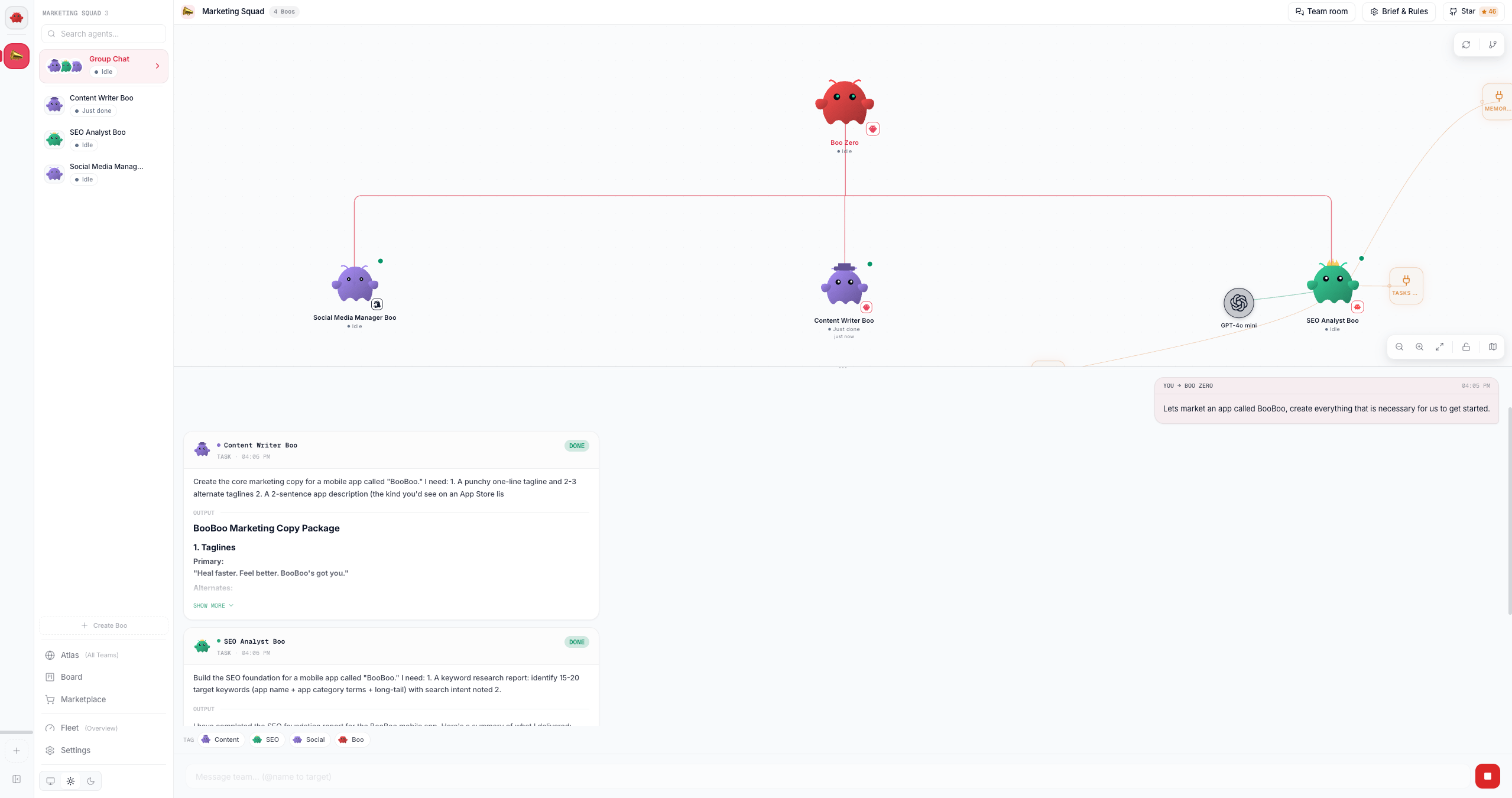
Clawboo’s core capability is orchestration: it runs heterogeneous runtimes as one team. Native agents are built in; paste a provider key and Clawboo runs them in-process, while Claude Code, Codex, Hermes, and the OpenClaw Gateway connect as peer teammates in the same room. They share one board, one memory, and one capability inventory, and their autonomous file-mutating work is independently verified before it counts as done.
What you get
Clawboo’s surface is wide on purpose; it’s a mission-control dashboard, not a single feature. The capabilities below are all shipped and on by default.- Five runtimes, one team. clawboo-native, OpenClaw, Claude Code, Codex, and Hermes all join as named peers. Each keeps its own native powers: OpenClaw keeps its channels and heartbeat, Hermes keeps its skills and self-improvement, while coordinating over the shared plane. See the runtime capability matrix.
- A durable board fused with live chat. The board is the canonical source of truth for task state; group chat is its narration. Tasks survive restarts, claims are race-free, and every delegation is a real board mutation; coordination flows over structured lifecycle events, never terminal-output scraping.
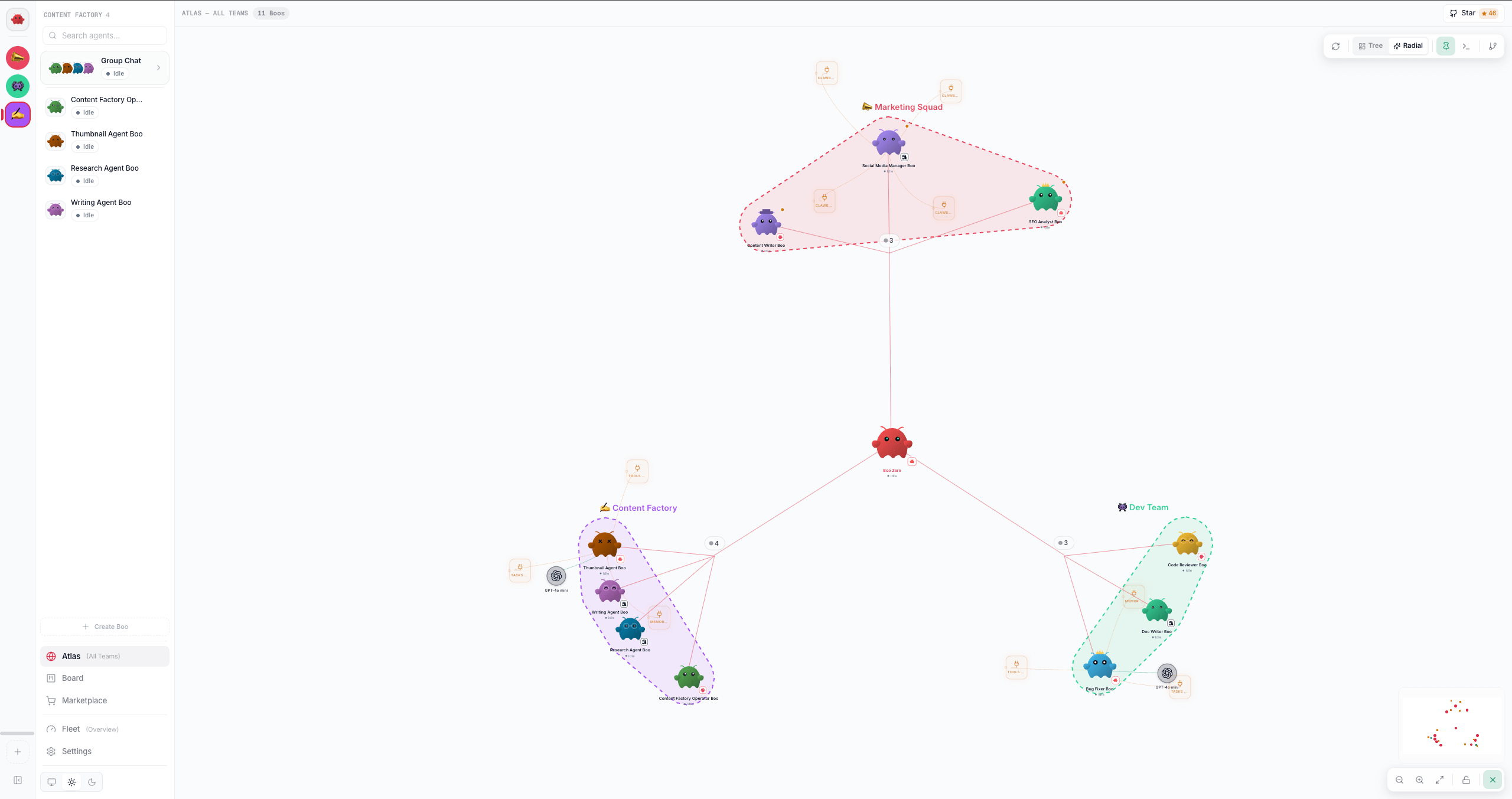
- Watch agents collaborate. The Ghost Graph and Atlas render your team as a live org chart; peer chat lets any runtime lead a bounded multi-turn exchange in one room.
- Builder ≠ judge verification. Autonomous completions pass through a verification gate: a deterministic check plus an independent critic. A failing verdict can’t reach
donewithout an audited override, and ambiguous results are markedcompleted_with_debtrather than silently passed. - Governance and observability, on by default. Budgets with spend warnings, depth and fan-out caps, circuit breakers, and approvals, plus an event log with traces, fleet health, and an error taxonomy. Hard spend caps that auto-pause a run are opt-in.
- Shared memory and a capability inventory. Every runtime reads and writes the same tiered memory store and shows up in one capabilities dashboard, while its private self-model stays its own.
- A 436-agent, 85-team marketplace. Browse and deploy from a catalog of curated agents and teams, then customize and route them.
Version
These docs describe Clawboo v0.3.1, the current release.
Where to go next
Getting Started
Two install paths: native-first (paste a key, no Gateway) or the OpenClaw Gateway. Start with installation and the native quickstart.
Core Concepts
The mental model: the agent model, teams and planes, the board, verification, and the architecture invariants.
Runtimes
The five-runtime capability matrix and how to connect each one as a peer teammate.
Reference
The REST API, database schema, environment variables, MCP tools, and the CLI.
See also
- What is Clawboo?: positioning and the wedge
- How it works: the end-to-end architecture
- Glossary: canonical term definitions