

Providers, models, runtimes and the Gateway
Four words come up whenever you connect AI to Clawboo. Each names a different layer.
So one agent might run on Clawboo Native with the model
llama3.2 from your local Ollama, while its teammate runs on Claude Code with your Anthropic key. One key can serve several runtimes: an Anthropic key works for Clawboo Native, Claude Code and Hermes.
Compare the runtimes
What the rows mean:
- Cost. Estimates count toward your budgets the same way real costs do. A model your own Ollama serves costs nothing, on Clawboo Native or OpenClaw, so its runs are recorded at $0 and read free. Budgets and spend explains how each runtime’s spend is worked out.
- Worktrees. A worktree is a separate checkout of a git repository for one task. No runtime gets one in team chat. Only a task run that names a repository does: one started through the REST API, or an agent Routine whose template names a repository. See Worktrees and handoff.
- Agent files. Clawboo Native uses
SOUL.mdas the agent’s instructions; Claude Code, Codex and Hermes get it as a persona at the top of each prompt. On every runtime,AGENTS.mdalso draws the agent’s links on the team graph. OpenClaw 2026.9 and later neither loads nor acceptsTOOLS.md, so Clawboo puts an OpenClaw agent’s tool notes inAGENTS.md. See Agents. - Commands. A new OpenClaw agent asks before running a command it hasn’t been allowed (Ask for Unknown). See OpenClaw. Hermes asks before the commands its own policy flags, such as a recursive delete, and each question is a card in Clawboo. See Hermes.
How to pick
- Start with Clawboo Native. It is built in, so there is nothing to install. Connect one provider key, or a local Ollama to run with no key at all. Onboarding sets it up first. See Clawboo Native.
- No API key, but a ChatGPT plan? Choose Sign in with ChatGPT in onboarding. Your team then runs on Codex and uses your plan instead of a per-token bill. See Run Clawboo without an API key.
- Coding work in a repository? Claude Code and Codex bring their own coding tools. Read the warning above first.
- Already use OpenClaw, or want its channels? OpenClaw agents keep their messaging channels and their own cron jobs on the Gateway, and join your teams in Clawboo.
- Want an agent that builds up skills over time? Hermes keeps a Hermes profile for each agent, where its skills, memory and its own scheduled jobs carry over between runs.
- Mix them. When you deploy a team, each member has its own runtime picker in Customize team, and Boo Zero leads them all. An agent keeps the runtime it was created on, so choose before you deploy. To move work to another runtime, create a new agent there.
Steering a running task
Steering means getting a message to an agent while it is still working on a task. Open the task in the board’s task drawer, a team chat’s Tasks card, or the agent’s Tasks & Routines card. Type your comment and click Send. The line beside Send tells you what will happen for that task, and once you send, a note under your comment says where it went. Unless the task is finished, Clawboo saves your comment as a wake on the task, and the run it brings reads it in its task block. A task the task runner runs reads it from the agent’s mailbox instead. If a run is working on the task right now, Clawboo also passes the comment into that run:
If the comment can’t get into the run (the run ended a moment earlier, or the runtime refused it), nothing is lost: the agent reads it at its next turn, and the note under the comment says so. On team chat work that turn comes before the task can be Done. When it does land, it leaves the wake, so the agent doesn’t read it twice. A comment on a task that is not running behaves by the task’s status: a task that waits on you, or waits in To do, starts again for it, and a finished task does not get it at all. Each case is in Steer a running task.
Under the hood: how each runtime takes a comment
Under the hood: how each runtime takes a comment
A person’s comment is posted with
POST /api/board/:taskId/comments and authorType: 'user', and the answer’s delivery field says where it went (see the Board API). Each runtime declares how it takes input mid-run in its steering capability: live (Clawboo Native, OpenClaw, Claude Code, Codex and Hermes) or interrupt-resume (a runtime that can take it only by stopping the run and resuming it; none of the five does today).- Clawboo Native queues the comment into the conversation as a user message for its next turn.
- OpenClaw gets it through
chat.sendwithqueueMode: 'steer'over the server’s own Gateway connection. If the run ends with the steer still unread, Clawboo cancels it (chat.abort) and the comment waits for the next turn. - Claude Code gets a user message pushed into the SDK’s streaming input.
- Codex gets
turn/steeron the app-server’s in-progress turn. - Hermes gets
POST /p/<profile>/v1/runs/<run>/steeron the Hermes gateway’s API server, which Hermes takes only while the run is running. It reaches the turn after its current tool calls, or before its next model call. A comment that arrives while Hermes writes its final answer runs as a follow-up turn in the same run, and one sent while the run waits on an approval waits for the next run.
Connect a runtime
Open Settings (Cmd/Ctrl + ,) and choose Runtimes under Workspace. Each runtime has a row with its status (Not installed, Needs key, Needs login or Connected) and one button: Install, Connect, Sign in (Codex) or Manage once it is connected. OpenClaw’s row offers Set up, Reconnect when its Gateway is offline, or Connect when it reads Not in use (set up, and nothing has needed its Gateway yet). From 0.9.0, a connected OpenClaw row also offers Connect this page while the page has no Gateway connection of its own (see Manage OpenClaw). A connected runtime with an update to make offers Update instead of Manage: Codex reads Update needed when its CLI is too old for your plan’s models (Codex), and Hermes reads Update needed when Clawboo’s own install of the current Hermes release is missing or older, as after a Hermes installed earlier with pip or pipx (Hermes).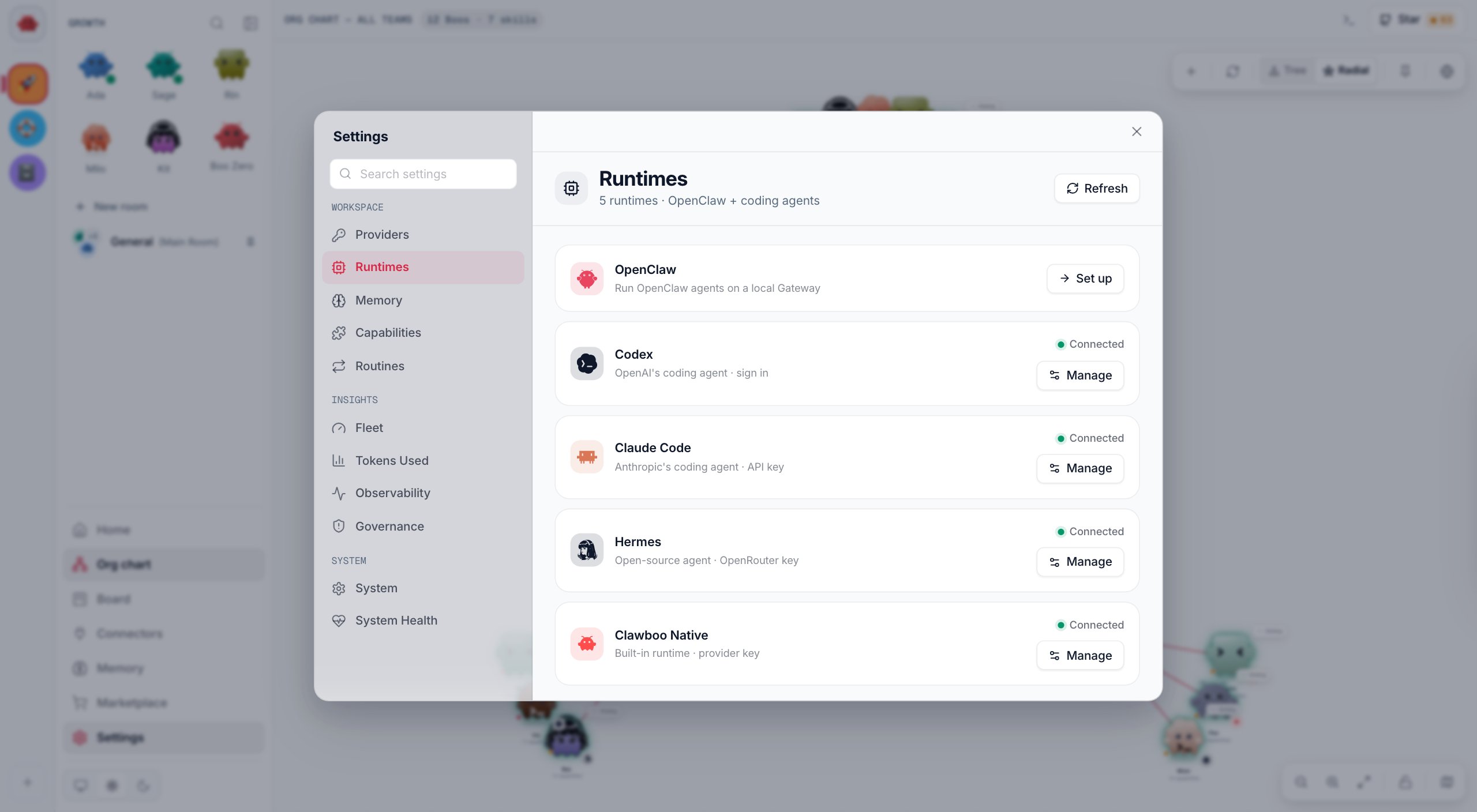
Under the hood: runtime ids and the REST API
Under the hood: runtime ids and the REST API
The runtime ids are
clawboo-native, openclaw, claude-code, codex and hermes. The /api/runtimes routes cover the four runtimes other than OpenClaw, so /api/runtimes/openclaw/... answers 404. OpenClaw is set up through /api/system/* and runs over the Gateway connection. See the Runtimes API and the System API.Each runtime’s adapter declares its capabilities (streaming, MCP, worktrees, steering, its runtime class and its home directory). The full matrix is in The runtime adapter.Related
- Clawboo Native: the built-in runtime, its providers and local Ollama
- OpenClaw: set up the Gateway, and what Clawboo runs and writes there
- Connect providers and runtimes: install, connect, sign in and disconnect
- What agents can do: each runtime’s access to your files, commands and network
- Budgets and spend: how each runtime’s cost reaches your budgets