> ## Documentation Index
> Fetch the complete documentation index at: https://docs.claw.boo/llms.txt
> Use this file to discover all available pages before exploring further.
# Connecting runtimes
> Install, connect, disconnect, and health-check the non-OpenClaw runtimes from the Runtimes panel.
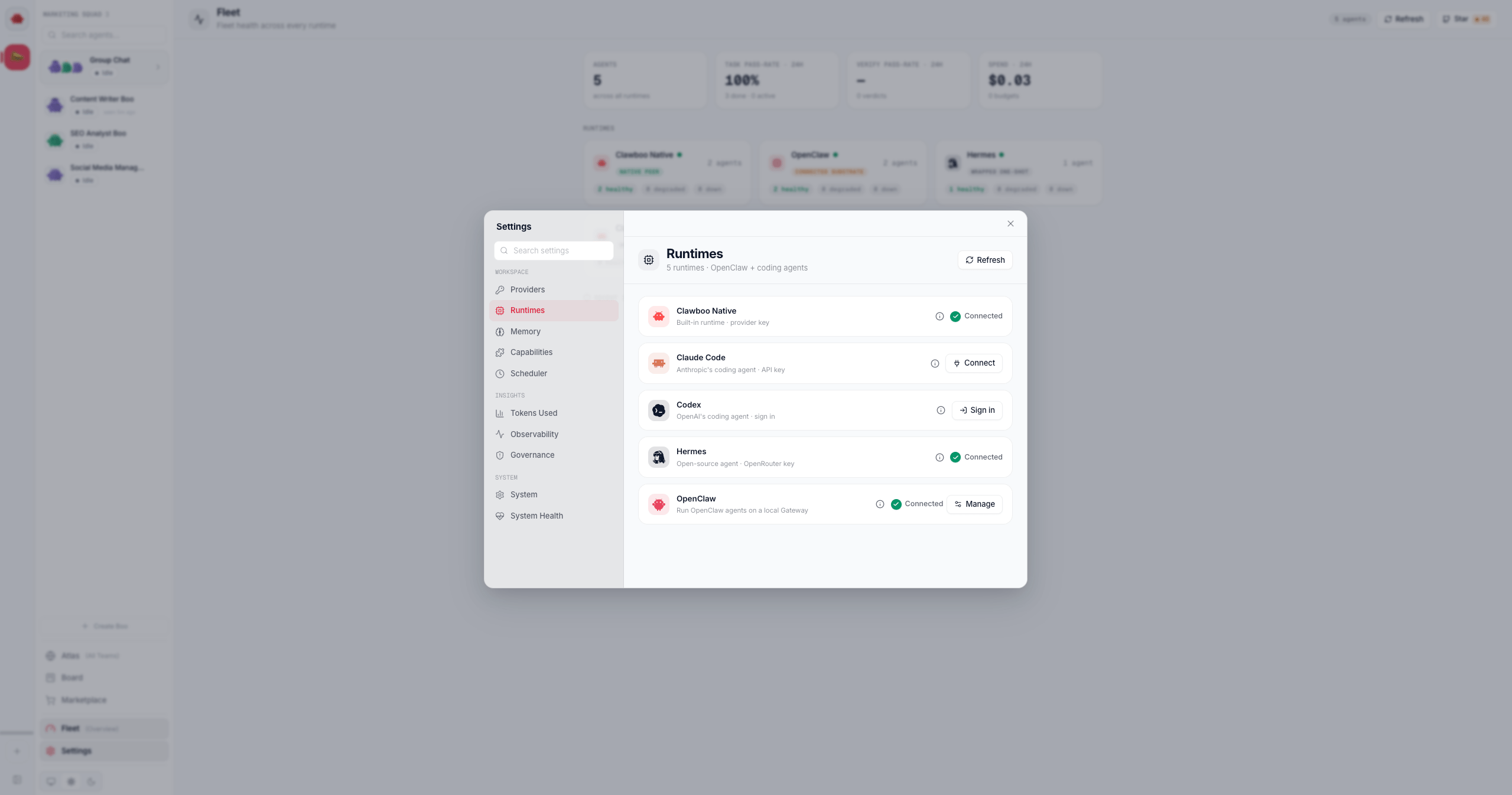
Use this page when you want to bring a non-OpenClaw [runtime](/appendices/glossary), `claude-code`, `codex`, `hermes`, or `clawboo-native`, online so it can execute board tasks. Each runtime is a [RuntimeAdapter](/appendices/glossary): Clawboo lists it, installs its CLI, stores its provider key, and reports its connection state. OpenClaw is connected differently (the Gateway, not a CLI install); see [OpenClaw](/runtimes/openclaw).
The whole lifecycle runs from the **Runtimes** panel (`RuntimeConnectionCard`), backed by `/api/runtimes/*`. Open it from **Settings** (the gear at the bottom of the sidebar, or `Cmd/Ctrl + ,`), then **Runtimes** under the Workspace group. This page documents what each step does, where keys are stored, and the per-runtime differences.
 ## Prerequisites
The Runtimes panel is always available; every runtime is listed regardless of install or credential state. What changes per runtime is whether it needs a CLI install, an API key, or an interactive terminal login.
* `claude-code`, `codex`, and `hermes` are external CLIs Clawboo installs for you. `clawboo-native` ships inside the Clawboo server; there is nothing to install.
* `npm` (bundled with Node.js) is required to install `claude-code` and `codex`. `hermes` installs via Python; `pipx` is preferred, with a `pip --user` fallback.
* A provider API key for the runtimes that authenticate head-less (`claude-code`, `hermes`, `clawboo-native`). `codex` authenticates through an interactive ChatGPT OAuth login instead of a pasted key — and `hermes` accepts the same ChatGPT-subscription login as a keyless ALTERNATIVE (`hermes auth add openai-codex`, then Re-check; see [Hermes](/runtimes/hermes#or-use-your-chatgpt-subscription)).
## At a glance
Every runtime resolves to one **connection state** that drives the card UI. The state is derived from `installed` + `hasCredential` + the runtime's auth model, and is recomputed (never echoing any secret) after each action.
| State | Meaning | Card action |
| --------------- | --------------------------------------------------------------- | -------------------------------------------------------------- |
| `not-installed` | CLI binary not found on PATH or known user-install dirs | **Install** (SSE) |
| `needs-auth` | Installed (api-key runtime) but no key stored | Paste key → **Connect** |
| `needs-login` | Installed (oauth runtime, i.e. `codex`), no pasted key possible | Run `codex login`, then **Re-check** |
| `ready` | Installed and credential present (or `none` auth) | **Re-check** · **Disconnect** (api-key) / **Sign out** (codex) |
| `unknown` | First status fetch in flight | **Re-check** |
## Per-runtime matrix
| Runtime | Built-in | Install | Auth | Env var written to vault | Notes |
| --------------------------------- | -------- | -------------------------------------------- | ------- | -------------------------------------------------------------------------------------------------------------------------------------------------------------------------------------------------------------- | ---------------------------------------------------------------------------------------------------------------------------------------------------------------------------------------------------- |
| `clawboo-native` (Clawboo Native) | yes | none | api-key | `ANTHROPIC_API_KEY` + nine alternates (`OPENAI_API_KEY`, `OPENROUTER_API_KEY`, `GEMINI_API_KEY`, `XAI_API_KEY`, `GROQ_API_KEY`, `MISTRAL_API_KEY`, `TOGETHER_API_KEY`, `CEREBRAS_API_KEY`, `MOONSHOT_API_KEY`) | In-process harness; multi-provider; a key for any of the ten supported providers (Anthropic, OpenAI, OpenRouter, Google, xAI, Groq, Mistral, Together, Cerebras, Moonshot) counts as connected |
| `claude-code` (Claude Code) | no | `npm install -g @anthropic-ai/claude-code@2` | api-key | `ANTHROPIC_API_KEY` | Health binary `claude` |
| `codex` (Codex) | no | `npm install -g @openai/codex@0` | oauth | none | Connects via `codex login`, not a pasted key; health binary `codex` |
| `hermes` (Hermes) | no | `pipx install 'hermes-agent[anthropic]<1'` | api-key | `OPENROUTER_API_KEY` | Python 3.11+ CLI; installs to the user-site bin (resolved off PATH); health binary `hermes`. Keyless alternative: a ChatGPT-subscription login (`hermes auth add openai-codex`) also reads Connected |
## Steps
### 1. List the runtimes
`GET /api/runtimes` returns `{ runtimes, available }`. Each `runtimes[]` entry carries the adapter's `participantKind`, `capabilities`, and `health`, plus its install/auth status (`installed`, `binPath`, `builtIn`, `authKind`, `envVar`, `hasCredential`, `installCommand`, `docsUrl`, `connectionState`). The `available[]` list is the full descriptor catalog (no secrets) so the panel can render "available to add" cards for runtimes you have not connected yet.
A built-in runtime (`clawboo-native`) always reports `installed: true` with `binPath: null`. A CLI runtime reports `installed` based on whether `resolveRuntimeBin` finds its health binary; this probe checks PATH **and** the well-known user-install dirs (the `pip --user` / `pipx` location), which is how Hermes is found even though its Python user-site bin is usually off the server's PATH.
### 2. Install the CLI (claude-code, codex, hermes)
`POST /api/runtimes/:id/install` is a Server-Sent Events stream. The card opens it from the `not-installed` state and renders the install log in a terminal box. Events:
| Event `type` | Payload | Meaning |
| ------------ | ----------------------------- | ------------------------------------------------------------------------------------------------------------------ |
| `progress` | `{ step, message }` | Phase marker (`installing`, `retrying`) |
| `output` | `{ line }` | A line of the installer's stdout/stderr |
| `error` | `{ code, message }` | Failure (`NPM_MISSING`, `PYTHON_MISSING`, `PYTHON_TOO_OLD`, `EACCES`, `SPAWN_THROW`, `SPAWN_ERROR`, `EXIT_
## Prerequisites
The Runtimes panel is always available; every runtime is listed regardless of install or credential state. What changes per runtime is whether it needs a CLI install, an API key, or an interactive terminal login.
* `claude-code`, `codex`, and `hermes` are external CLIs Clawboo installs for you. `clawboo-native` ships inside the Clawboo server; there is nothing to install.
* `npm` (bundled with Node.js) is required to install `claude-code` and `codex`. `hermes` installs via Python; `pipx` is preferred, with a `pip --user` fallback.
* A provider API key for the runtimes that authenticate head-less (`claude-code`, `hermes`, `clawboo-native`). `codex` authenticates through an interactive ChatGPT OAuth login instead of a pasted key — and `hermes` accepts the same ChatGPT-subscription login as a keyless ALTERNATIVE (`hermes auth add openai-codex`, then Re-check; see [Hermes](/runtimes/hermes#or-use-your-chatgpt-subscription)).
## At a glance
Every runtime resolves to one **connection state** that drives the card UI. The state is derived from `installed` + `hasCredential` + the runtime's auth model, and is recomputed (never echoing any secret) after each action.
| State | Meaning | Card action |
| --------------- | --------------------------------------------------------------- | -------------------------------------------------------------- |
| `not-installed` | CLI binary not found on PATH or known user-install dirs | **Install** (SSE) |
| `needs-auth` | Installed (api-key runtime) but no key stored | Paste key → **Connect** |
| `needs-login` | Installed (oauth runtime, i.e. `codex`), no pasted key possible | Run `codex login`, then **Re-check** |
| `ready` | Installed and credential present (or `none` auth) | **Re-check** · **Disconnect** (api-key) / **Sign out** (codex) |
| `unknown` | First status fetch in flight | **Re-check** |
## Per-runtime matrix
| Runtime | Built-in | Install | Auth | Env var written to vault | Notes |
| --------------------------------- | -------- | -------------------------------------------- | ------- | -------------------------------------------------------------------------------------------------------------------------------------------------------------------------------------------------------------- | ---------------------------------------------------------------------------------------------------------------------------------------------------------------------------------------------------- |
| `clawboo-native` (Clawboo Native) | yes | none | api-key | `ANTHROPIC_API_KEY` + nine alternates (`OPENAI_API_KEY`, `OPENROUTER_API_KEY`, `GEMINI_API_KEY`, `XAI_API_KEY`, `GROQ_API_KEY`, `MISTRAL_API_KEY`, `TOGETHER_API_KEY`, `CEREBRAS_API_KEY`, `MOONSHOT_API_KEY`) | In-process harness; multi-provider; a key for any of the ten supported providers (Anthropic, OpenAI, OpenRouter, Google, xAI, Groq, Mistral, Together, Cerebras, Moonshot) counts as connected |
| `claude-code` (Claude Code) | no | `npm install -g @anthropic-ai/claude-code@2` | api-key | `ANTHROPIC_API_KEY` | Health binary `claude` |
| `codex` (Codex) | no | `npm install -g @openai/codex@0` | oauth | none | Connects via `codex login`, not a pasted key; health binary `codex` |
| `hermes` (Hermes) | no | `pipx install 'hermes-agent[anthropic]<1'` | api-key | `OPENROUTER_API_KEY` | Python 3.11+ CLI; installs to the user-site bin (resolved off PATH); health binary `hermes`. Keyless alternative: a ChatGPT-subscription login (`hermes auth add openai-codex`) also reads Connected |
## Steps
### 1. List the runtimes
`GET /api/runtimes` returns `{ runtimes, available }`. Each `runtimes[]` entry carries the adapter's `participantKind`, `capabilities`, and `health`, plus its install/auth status (`installed`, `binPath`, `builtIn`, `authKind`, `envVar`, `hasCredential`, `installCommand`, `docsUrl`, `connectionState`). The `available[]` list is the full descriptor catalog (no secrets) so the panel can render "available to add" cards for runtimes you have not connected yet.
A built-in runtime (`clawboo-native`) always reports `installed: true` with `binPath: null`. A CLI runtime reports `installed` based on whether `resolveRuntimeBin` finds its health binary; this probe checks PATH **and** the well-known user-install dirs (the `pip --user` / `pipx` location), which is how Hermes is found even though its Python user-site bin is usually off the server's PATH.
### 2. Install the CLI (claude-code, codex, hermes)
`POST /api/runtimes/:id/install` is a Server-Sent Events stream. The card opens it from the `not-installed` state and renders the install log in a terminal box. Events:
| Event `type` | Payload | Meaning |
| ------------ | ----------------------------- | ------------------------------------------------------------------------------------------------------------------ |
| `progress` | `{ step, message }` | Phase marker (`installing`, `retrying`) |
| `output` | `{ line }` | A line of the installer's stdout/stderr |
| `error` | `{ code, message }` | Failure (`NPM_MISSING`, `PYTHON_MISSING`, `PYTHON_TOO_OLD`, `EACCES`, `SPAWN_THROW`, `SPAWN_ERROR`, `EXIT_`) |
| `complete` | `{ success: true, warning? }` | Install finished; `warning` set if the binary still is not resolvable |
* **npm runtimes** (`claude-code`, `codex`) run `npm install -g `. If `npm` is not found, the stream emits `error` with code `NPM_MISSING`.
* **The pip runtime** (`hermes`) prefers `pipx install `. If `pipx` is absent it falls back to `python -m pip install --user `, and if it detects a PEP-668 externally-managed environment it retries once with `--break-system-packages`. If neither `pipx` nor `python` is found it emits `error` with code `PYTHON_MISSING`. If `pipx` is absent and the only Python it can resolve is older than the runtime's minimum (3.11 for Hermes), it emits `PYTHON_TOO_OLD` instead, naming the version it found and suggesting a newer Python or `pipx`.
* Calling install on a built-in runtime returns `400` (plain JSON, the SSE stream never opens); `clawboo-native` has nothing to install.
A global npm install can hit `EACCES`. When the installer's stderr contains `EACCES` or "permission denied", the stream emits an `error` event suggesting `sudo `. Prefer a Node version manager (nvm/fnm) or Homebrew over `sudo`.
### 3. Connect (api-key runtimes)
`POST /api/runtimes/:id/connect` with body `{ apiKey, provider? }` stores the key in the [encrypted vault](#where-keys-are-stored) and returns the recomputed `connectionState`. The key is trimmed. An empty key returns `400` (`{ error: "apiKey is required" }`), with one exception: for `clawboo-native` with an explicit `provider`, omitting `apiKey` is a keyless reconnect against a key that already resolves for that provider (`200`, nothing stored). That is what the Providers manager's one-click **Use** sends; when nothing resolves for that provider the `400` reads `no existing key found for ` instead. **The response never echoes the key.**
The card sends the key from the `needs-auth` state (the input label is the runtime's `envVar`, with a show/hide toggle). On success it clears the input and re-fetches status, which flips the card to `ready`.
For `clawboo-native` the optional `provider` field routes the key to the right vault slot. Without it, the key lands in `ANTHROPIC_API_KEY`; with `provider: "openai"` or `"openrouter"` it goes to that provider's env var (validated against the runtime's known set), and `provider: "ollama"` is a keyless no-op (nothing is stored).
### 4. Connect (codex, oauth)
`codex` cannot be connected with a pasted key on current versions. `POST /api/runtimes/codex/connect` is a no-op on storage that probes the login (`codex login status`) and returns the CURRENT state — `ready` when you are already signed in, else:
```json theme={"theme":{"light":"github-dark","dark":"github-dark"}}
{ "ok": true, "connectionState": "needs-login", "loginCommand": "codex login" }
```
The card offers a one-click **Sign in with ChatGPT** (Clawboo's local server runs `codex login` for you; the CLI opens your browser and you approve there — no code to type). The manual `codex login` command remains the fallback: run it in a terminal, then click **Re-check**. A signed-in Codex is detected by the status probe (the token file is never read), and each spawned run gets a managed `CODEX_HOME` seeded with a copy of your `~/.codex/auth.json`; Clawboo does not store a Codex credential in its vault. The subscription's primary home is the Providers page (the **ChatGPT subscription** row) and the onboarding wizard's OpenAI card (see [Codex](/runtimes/codex)); once it is connected, the Hermes and OpenClaw surfaces offer their own optional subscription links.
### 5. Health-check a provider key
`POST /api/runtimes/clawboo-native/healthcheck` with body `{ provider, apiKey? }` verifies a credential **before** anything commits to it. Every clawboo surface that takes or reuses a key runs this first — the onboarding step on **Continue**, the Providers hub on **Save**, the runtime connect card before it writes the vault, and the Providers manager's **Use** before it reconnects on a saved key. On the normal path a credential that doesn't answer is not stored: the surface shows the reason inline and stops. Each one also offers an explicit override — **Continue anyway** / **Save anyway** / **Connect anyway** / **Use anyway** — and choosing it deliberately stores the credential unverified, so a provider this machine simply can't reach can't strand you.
It makes a single authenticated `GET` to the provider's lightweight models/health endpoint:
| `provider` | Endpoint probed |
| ---------------------------------------------------------------------- | -------------------------------------- |
| `anthropic` | `https://api.anthropic.com/v1/models` |
| `openai` | `https://api.openai.com/v1/models` |
| `openrouter` | `https://openrouter.ai/api/v1/models` |
| `google`, `xai`, `groq`, `mistral`, `together`, `cerebras`, `moonshot` | that provider's `/models` |
| `ollama` | `/api/tags` (keyless) |
It returns `{ ok: true }` on a 2xx, or `{ ok: false, error }` on a bad key (`401`/`403` → "Invalid API key."), an 8-second timeout, or a network failure. **The key is used for exactly that one fetch, never persisted to the vault, never logged, never echoed.** This route is only valid for `clawboo-native`; any other runtime id returns `400`. `apiKey` is optional — omit it to probe the key already stored for that provider; `400` if nothing is stored either. An unknown provider also returns `400`.
### 6. Disconnect
`POST /api/runtimes/:id/disconnect` deletes the runtime's stored credential and returns the recomputed `connectionState`. It keeps the CLI installed, so the card drops from `ready` to `needs-auth`. A connected runtime shows the button in its **Manage** body, and it confirms first, since you will need to re-enter the key to reconnect. For `codex` the button is labelled **Sign out** and calls the logout route below instead; `POST /api/runtimes/codex/disconnect` (no `envVar`) has no stored credential to delete and is not wired to any button.
### 7. Sign out (codex)
`POST /api/runtimes/:id/logout` is the oauth counterpart to Disconnect. It runs the CLI's own `codex logout`, invalidates the cached auth probe, and re-probes, so the returned `connectionState` reflects the real post-logout state. It returns `404` (`{ error: "runtime '' has no sign-out" }`) for an api-key runtime, which uses `/disconnect`, and `400` if the CLI is not installed.
## Where keys are stored
API keys live in an **encrypted vault** at `~/.clawboo/secrets/runtime-keys.json` (under `resolveClawbooDir()`; the `CLAWBOO_HOME` override applies), keyed by env-var name. Each value is encrypted with AES-256-GCM under a 32-byte master key at `~/.clawboo/secrets/master.key` (mode `0600`, inside a `0700` dir). `CLAWBOO_SECRETS_MASTER_KEY` overrides the on-disk key (32-byte base64, 64 hex chars, or a raw 32-char string).
At run time the key is resolved by `resolveRuntimeKey(envVar)`, highest priority first:
1. `process.env[envVar]`
2. the encrypted vault (decrypt)
3. OpenClaw's `~/.openclaw/.env`
This is defense in depth. The decrypted value is never logged, never returned in an HTTP response body, and never written to SQLite, audit, or observability records; it flows only into a spawned runtime process's environment. A wrong, rotated, or lost master key fails closed (resolution returns `null`); it never throws into a request or leaks partial plaintext.
Because `resolveRuntimeKey` falls back to `process.env` and OpenClaw's `.env`, a runtime can already read as connected without an explicit Connect. For example, if `ANTHROPIC_API_KEY` is exported in the server's environment or present in `~/.openclaw/.env`, both `claude-code` and `clawboo-native` resolve a credential and report `ready`.
## Verify it worked
* Re-fetch `GET /api/runtimes` (or click **Re-check** in the card). The runtime's `connectionState` should read `ready`, and its `health.ok` should be `true`.
* For CLI runtimes, `health` reports the binary presence; for `clawboo-native`, `health` reports whether any routable provider key (or `OLLAMA_BASE_URL`) resolves.
* Run a board task on the runtime via `POST /api/runtimes/:id/run`; the connected key is injected from the vault into the spawned process's environment.
## Troubleshooting
**Hermes installs but reads as not-installed.** The `hermes` binary lands in the Python user-site bin, which is usually off the server's PATH. Clawboo resolves it via `resolveRuntimeBin` (PATH plus the known user-install dirs), so this is normally handled; but a fresh install's `complete` event may carry a `warning` if the binary is not yet resolvable, in which case restart the server.
**Codex shows "Needs login" after a successful `codex login`.** Click **Re-check** to re-probe (`codex login status` is parsed; a signed-in Codex reads `ready`). Codex never reaches `ready` from a vault key; its auth lives in `CODEX_HOME`.
**`POST /api/runtimes/:id` with an unknown `:id`** returns `404` (`{ error: "unknown runtime ''" }`). Only `claude-code`, `codex`, `hermes`, and `clawboo-native` are valid ids; OpenClaw is not a `/api/runtimes` runtime.
## Related
* [Runtimes overview](/runtimes/index): the capability matrix
* [Clawboo Native](/runtimes/native) · [Claude Code](/runtimes/claude-code) · [Codex](/runtimes/codex) · [Hermes](/runtimes/hermes)
* [OpenClaw](/runtimes/openclaw): the Gateway runtime (different connection model)
* [`/api/runtimes` reference](/reference/rest-api/runtimes): full request/response shapes
* [Security](/operating/security): the vault, redaction, and safe exposure
* [Environment variables](/reference/environment-variables): `CLAWBOO_HOME`, `CLAWBOO_SECRETS_MASTER_KEY`, `OLLAMA_BASE_URL`